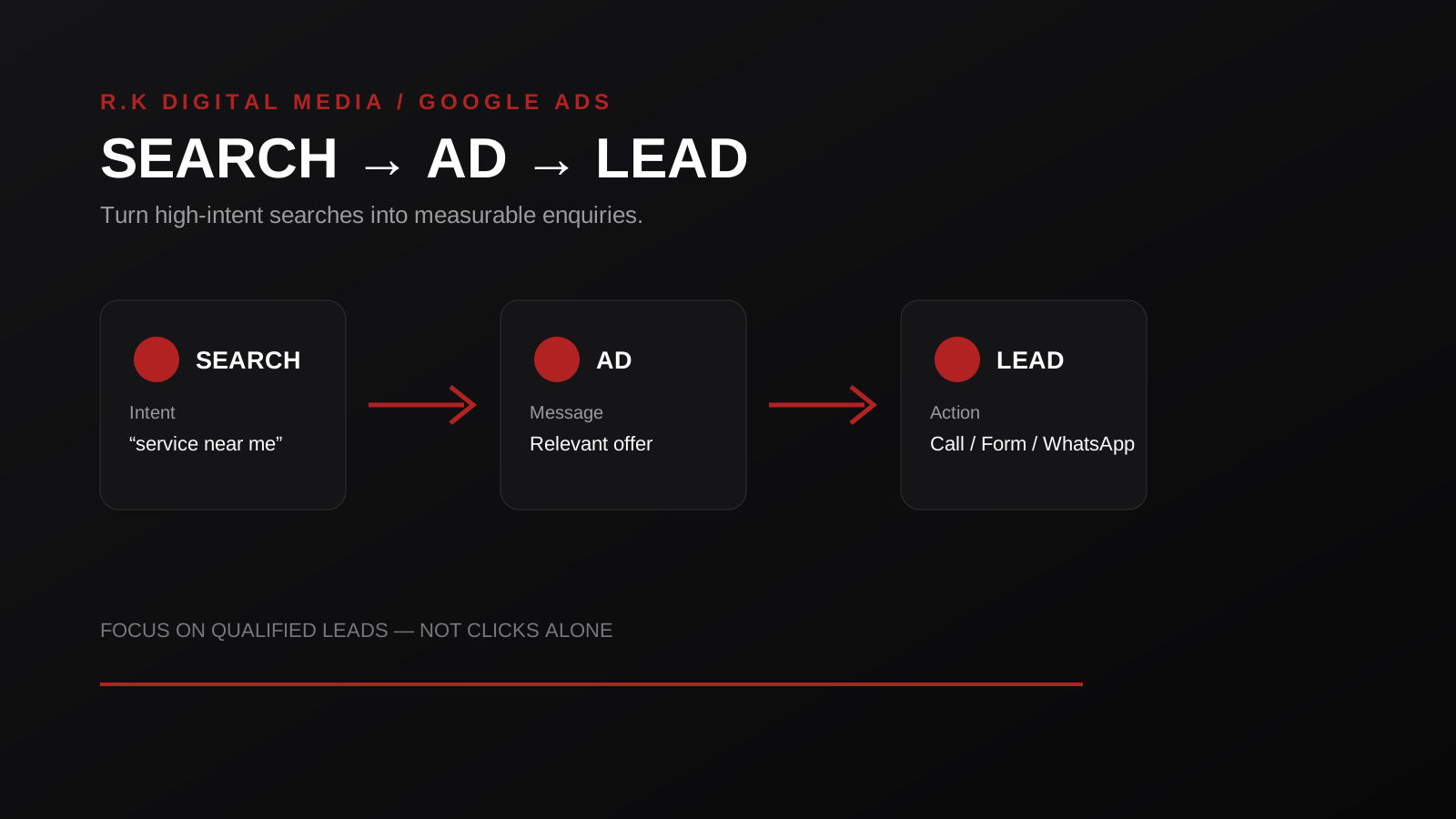
// READ THIS FIRST
The useful part of a guide is what you can actually apply. The recommendations below focus on decisions, trade-offs and practical execution—not promises of guaranteed rankings, leads or returns.
// 01 — STRATEGY
Strategy and account setup
Management should begin with the business objective, target audience, geography, offer and expected conversion path. Campaigns and budgets should then be structured around those requirements.
The setup should be documented well enough that another qualified person can understand what the account is trying to achieve.
// 02 — KEYWORDS
Keyword and search-term management
Search campaigns require ongoing attention to the queries that trigger ads. Relevant searches can be expanded while irrelevant or unsuitable traffic can be controlled using appropriate targeting and negative-keyword processes.
The goal is not simply to maximise keyword count; it is to improve the relevance and economics of paid traffic.
// 03 — CREATIVE
Ads and landing-page alignment
Ad copy should communicate the offer clearly and match the landing page. Management may involve testing messages, calls to action and extensions or assets where relevant.
Landing pages should support the intent that brought the visitor to the site rather than forcing every campaign into the same generic page.
// 04 — TRACKING
Conversion tracking
A management service should verify that important conversion actions are being recorded correctly. This can include forms, calls, bookings or other defined lead actions.
Tracking should be reviewed when websites, forms or measurement systems change.
// 05 — OPTIMISATION
Ongoing optimisation
- Search-term and keyword review.
- Budget allocation across campaigns.
- Bid and targeting adjustments.
- Ad and asset testing.
- Conversion-rate and landing-page review.
- Quality and relevance checks.
- Investigation of unusual performance changes.
// 06 — REPORTING
Reporting and decision-making
A useful report should explain spend, conversions, cost efficiency, notable changes and the actions planned next. The exact metrics depend on the campaign objective.
Reporting should support decisions rather than create a monthly list of platform screenshots.
// 07 — PROPOSAL
What should be included in a Google Ads management proposal
- Campaign setup and restructuring scope.
- Conversion tracking responsibilities.
- Keyword and search-term management.
- Ad and asset testing.
- Landing-page recommendations or implementation scope.
- Optimisation frequency and process.
- Reporting cadence and included metrics.
- Management fee versus advertising spend.
- Account access and ownership terms.
// 08 — FAQ
Frequently Asked Questions
What are Google Ads management services?
They are ongoing services used to plan, operate, measure and optimise Google Ads campaigns against defined business objectives.
Is Google Ads management the same as ad spend?
No. Advertising spend is paid to Google for media placement. Management fees compensate the person or agency operating and optimising the campaigns.
How often should Google Ads campaigns be optimised?
The appropriate frequency depends on spend, conversion volume, campaign maturity and volatility. Important issues should be reviewed promptly, while larger strategic changes should be based on enough data to make a sound decision.
Can management services guarantee a specific cost per lead?
No. Cost per lead depends on competition, search demand, offer quality, landing-page experience, conversion rate and other factors outside an agency's direct control.
// RELATED RESOURCES
// NEXT STEP
Want help putting this into practice?
R.K Digital Media works on practical search, paid advertising and digital growth systems. Start with a conversation about your actual goals—not a generic package.
Explore the relevant service