// READ THIS FIRST
The useful part of a guide is what you can actually apply. The recommendations below focus on decisions, trade-offs and practical execution—not promises of guaranteed rankings, leads or returns.
// 01 — GOAL
Start with one clear business goal
A small business should begin with a measurable outcome such as qualified enquiries, booked appointments, calls or purchases. Campaign settings should follow that outcome rather than trying to generate every possible type of traffic.
A focused goal also makes it easier to decide which keywords, locations, landing pages and conversion actions deserve budget.
// 02 — TARGETING
Choose high-intent searches first
Search campaigns can be useful for small businesses because they can respond to people actively looking for a product or service. Start with searches that show a realistic commercial intent instead of trying to cover every broad topic.
- Prioritise terms closely connected to the service or product you actually sell.
- Use location targeting that reflects where you can genuinely serve customers.
- Review search terms regularly and remove irrelevant demand.
- Separate different services when their intent, economics or landing pages differ.
// 03 — BUDGET
Set a budget you can learn from
There is no universal minimum budget that guarantees results. Your budget should be large enough to generate useful data while remaining commercially responsible for the business.
If demand is limited, increasing spend does not automatically create more qualified customers. Improve targeting and conversion quality before assuming the answer is simply a larger budget.
// 04 — LANDING PAGE
Build a landing page that matches the ad
The click is only the beginning. The landing page should make the offer clear, reinforce the search intent and give visitors an obvious next action.
- Match the page headline to the service or offer advertised.
- Make contact options easy to find on mobile.
- Explain trust signals, service scope and relevant proof without unnecessary clutter.
- Keep the form or enquiry process proportionate to the value of the customer.
// 05 — MEASUREMENT
Track meaningful conversions
Clicks and impressions describe traffic, not business results. For lead generation, track actions such as qualified forms, calls or bookings where possible.
Conversion tracking should be reviewed before making aggressive optimisation decisions. Poor tracking can make a campaign look successful or unsuccessful for the wrong reason.
// 06 — OPTIMISATION
Optimise before increasing spend
A small account can often improve through better search-term quality, targeting, ads, landing-page alignment and budget allocation. Review the evidence first, then scale what is producing useful outcomes.
Do not judge an account from one metric. Look at conversion quality, cost per useful outcome and whether the customers generated are commercially valuable.
// 07 — FIT
When Google Ads makes sense for a small business
Google Ads can be a strong acquisition channel when customers actively search for the service, the business can respond to enquiries and the economics support paid acquisition.
It may be less suitable when the offer is unclear, the market has little search demand or the business cannot handle additional enquiries. In those cases, fixing the underlying constraint comes first.
// 08 — FAQ
Frequently Asked Questions
How much should a small business spend on Google Ads?
There is no responsible universal number. Start with a budget the business can sustain while collecting enough data to evaluate search quality, conversion rate and customer economics.
Are Google Ads good for local businesses?
They can be, particularly when customers actively search for local services. Location targeting, relevant landing pages and accurate conversion tracking are important.
Should a small business run multiple campaign types?
Not necessarily. Start with the campaign type most closely aligned with the business goal and available search or audience demand. Expand when there is a clear reason to do so.
What is more important: clicks or leads?
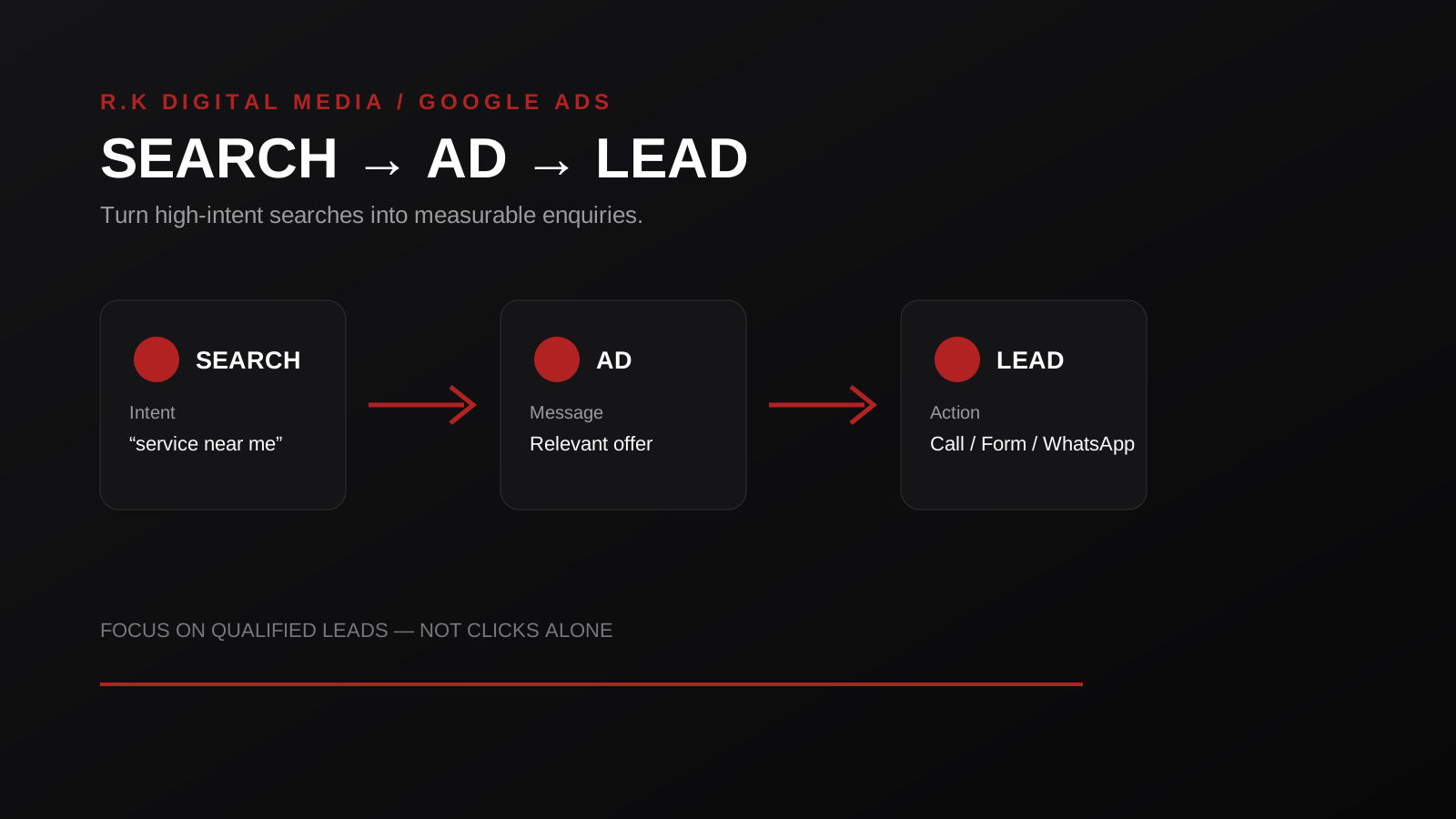
For lead-generation businesses, qualified leads and the downstream value of those leads are more useful than raw click volume.
// RELATED RESOURCES
// NEXT STEP
Want help putting this into practice?
R.K Digital Media works on practical search, paid advertising and digital growth systems. Start with a conversation about your actual goals—not a generic package.
Explore the relevant service