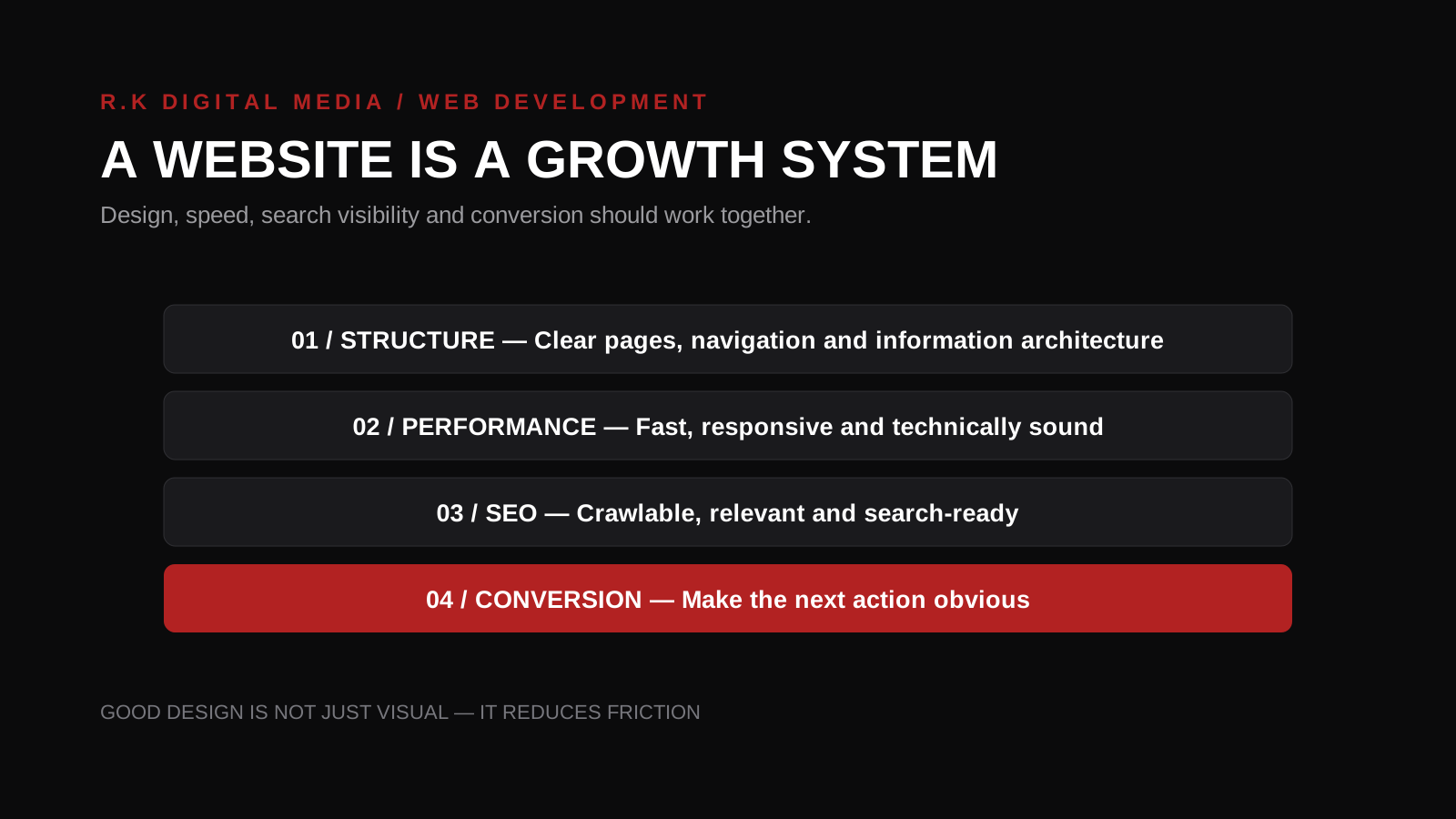
// READ THIS FIRST
The useful part of a guide is what you can actually apply. The recommendations below focus on decisions, trade-offs and practical execution—not promises of guaranteed rankings, leads or returns.
// 01 — STRATEGY
Start with the business goal
Before comparing agencies, define what the website must accomplish. A service business may need qualified enquiries and calls; an ecommerce business may need product discovery and purchases; a professional firm may need credibility and lead qualification.
This goal should influence the information architecture, calls to action, content model, analytics and technology choices.
// 02 — TECHNOLOGY
Evaluate the technical approach
The technology should fit the project rather than being selected because it is fashionable. Ask how the team handles performance, reusable components, forms, integrations, content updates, security and future changes.
Ask what you will actually own
Clarify ownership of the domain, hosting account, source code, CMS content, design assets, analytics and third-party accounts. Your business should not become dependent on an agency simply because the credentials are held elsewhere.
Ask how changes will be managed
A good development process should make future improvements predictable. Understand who handles bugs, content changes, feature requests, backups and deployment.
// 03 — SEO
Check SEO readiness before launch
A website can look excellent and still launch with weak search foundations. Make sure the development process accounts for crawlability, indexable content, page titles, headings, canonical URLs, XML sitemap generation, internal linking, structured data where appropriate and redirects when URLs change.
SEO should not be treated as something to bolt on after launch if organic search is an important acquisition channel.
- Clear URL structure and indexable page content.
- Unique, useful titles and meta descriptions.
- Mobile-friendly layouts and accessible navigation.
- Fast pages and sensible asset handling.
- Analytics and Search Console readiness.
- A redirect plan for important legacy URLs when a redesign changes the structure.
// 04 — UX
Test mobile performance and user experience
Most businesses need a website that works well on mobile, not merely one that technically shrinks to a small screen. Test navigation, forms, phone links, buttons, content spacing, readability and page speed on real devices.
A strong design also reduces friction. Visitors should quickly understand what you do, who you serve, why they should trust you and what to do next.
// 05 — OWNERSHIP
Clarify ownership, security and maintenance
Ask what happens after launch. Confirm access to the domain, hosting, repository or CMS, analytics, DNS and other critical services. Understand the backup and security process and whether maintenance is included.
If the site is built on a managed platform, clarify the platform costs and what happens if you later move providers.
// 06 — CONVERSION
Review conversion tracking and lead flow
A business website should make important actions measurable. Depending on the business, that can include contact forms, calls, WhatsApp clicks, bookings, quote requests or purchases.
The development team should coordinate with the marketing strategy so tracking is implemented correctly and the website supports the campaigns and search traffic that will eventually reach it.
Do not optimise only for design
Visual quality matters, but the final test is whether the site makes the intended customer journey easier. A beautiful page with a confusing offer or broken form is still a weak business asset.
// 07 — CHECKLIST
Questions to ask before hiring a website development company
- Can I see relevant examples of websites you have built?
- Who owns the domain, hosting and source code after launch?
- How is the site made responsive and tested on mobile?
- What SEO foundations are included in development?
- How are forms, calls and other lead actions tracked?
- What is included in post-launch support?
- How are backups, security updates and bug fixes handled?
- What happens if I need another developer or agency later?
// 08 — DECISION
Choose the team that can support the whole growth system
For a business in Noida, the best development partner is not necessarily the one with the longest feature list. Look for a team that understands the relationship between website architecture, SEO, paid acquisition, analytics and conversion.
The website should become a dependable foundation for marketing rather than a one-time design project.
// 09 — FAQ
Frequently Asked Questions
What should I look for in a website development company in Noida?
Look for relevant experience, clear ownership terms, strong technical and SEO practices, mobile performance, transparent maintenance and a development process that supports your actual business goals.
Should SEO be included in website development?
At minimum, the website should be built with sound SEO foundations. Ongoing SEO is a separate discipline, but development decisions can strongly affect crawlability, performance, content structure and search visibility.
How much does website development cost in Noida?
Cost depends on the number and type of pages, design complexity, integrations, content requirements, ecommerce or booking features, technology and ongoing support. Compare the scope rather than choosing on a headline price.
Who should own the website after development?
The business should retain access and practical control of critical assets such as the domain, hosting, source code or CMS, analytics and DNS. Your contract should make ownership and handover responsibilities clear.
// RELATED RESOURCES
// NEXT STEP
Want help putting this into practice?
R.K Digital Media works on practical search, paid advertising and digital growth systems. Start with a conversation about your actual goals—not a generic package.
Explore the relevant service